
After reading this article from Mike Boyle about training a young female hockey team, I reflected on the summer training we just completed with the SHS girls’ soccer team.
https://www.otpbooks.com/mike-boyle-lessons-coaching-kids/
Boyle talks about keeping it simple and taking into consideration what is the priority. Since he was coaching the hockey team in season, his priority was learning weight training technique vs developing strength, speed or work capacity. The latter are for post season when the athletes don’t have as many competing demands.
We used a similar mindset to achieve success with the SHS girls’ soccer team. We tested 9 different qualities before they started training. The 3 major categories were fitness (300yd shuttle test), split squat (lower body strength) and vertical jump (lower body power). For our purposes, these three were our essential qualities and we programmed in this order. The main priority was to improve work capacity. The secondary gain would be to increase lower body strength, and the third would lower body power.
 Mike Boyle: Three Lessons I Learned from Coaching Kids – …
Here’s a sad truth: The higher the level you work at, the more spoiled you get. I’ve been spoiled by training primarily professional and Olympic athletes. Coaching great athletes is challenging and fulfilling, but it can give you a false sense of …
Read more
http://www.otpbooks.com
In his article, Boyle mentions that you need to have 2 different programs based on training age and also ability. In our case, we had 3-4 different templates that athletes were using based on their testing and movement screens. Some of our athletes had a very different program due to a broken fibula or chronic pain in a hip. However, by the end of the summer, the majority of girls were doing similar programs as a result of their progression, and were now able to handle more complex training.
This is where I believe the article really hits home for what we should be expecting from a training program and what will yield the most success. Here are a few key points:
· Know when it is time to push and when to learn.
Keep it simple. Learn how to go through a training session, maybe do some targeted recovery strategies and develop ways to maintain your performance capacity. Then during the off season, you should be able to implement more complex training with higher performance emphasis.
· Figure out what is important.
Coach Boyle wanted his athletes to learn the Clean(Olympic lift) and front squat. For us, I really wanted the girls to develop more work capacity and gain lower body strength. This made programming easier and the girls quickly picked up on it because we constantly did quality repetitions.
· Set the ground rules and expectations. Chat while foam rolling, but once we start the program, focus on your work until we break out the spike ball net.
We trained 35 athletes, for an hour, 2x/week over a six week period.
Here are the results:
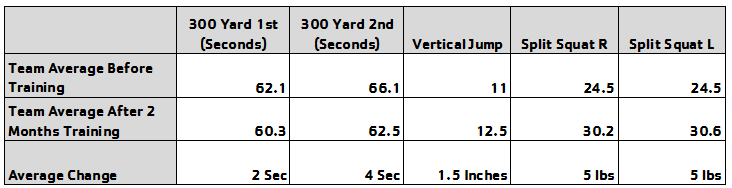
To put this into context, we want our 300yd shuttle run as close to 60 seconds as possible and the 2nd attempt to be within 2 seconds of the first. This shows fitness but also recovery. We added 1.5 inches onto their vertical jumps. Our goal is to get everyone as close to 15inches. Split squat right and left leg were relative to bodyweight. But as you can see, our average went up by 5lbs on each leg(total 10lbs).
From a long term developmental model, the goal would be to train these athletes again for another 6-12 week block after their season and try to obtain the same rate of improvement with each category. By the next year, you would have a whole team running sub 60 second shuttle runs, jumping 14 inches and split squatting 70lbs total for eight reps on each leg.
With that kind of preparation (foundation), NOW you can really focus on skill development.
Just imagine the success…
 TS Training Systems