
The Goal and Variables
Many variables had to be taken into account when devising a training program that would allow for the group, of mostly untrained females athletes, to see an improvement in work capacity and strength. Variables such as existing injuries and time limitations had to be considered.
Before training began, 20 out of the 35 girls had some kind of painful pattern (or existing injury).
Being summer break, the athletes trained 2 times a week for 6 weeks. In some cases, athletes would be training for 2 weeks and then go on vacation for a week.
It was clear that training had to be simple enough that they could pick up right where they left off but also still deliver enough of a stimulus that they wouldn’t lose too much progress while on vacation.
The Results
At the beginning and end of the summer the girls completed a series of exercises to test their progress here are the before and after results of the training first and then we will walk back through the training program that accomplished this.
Graph of the change in lifting capacity
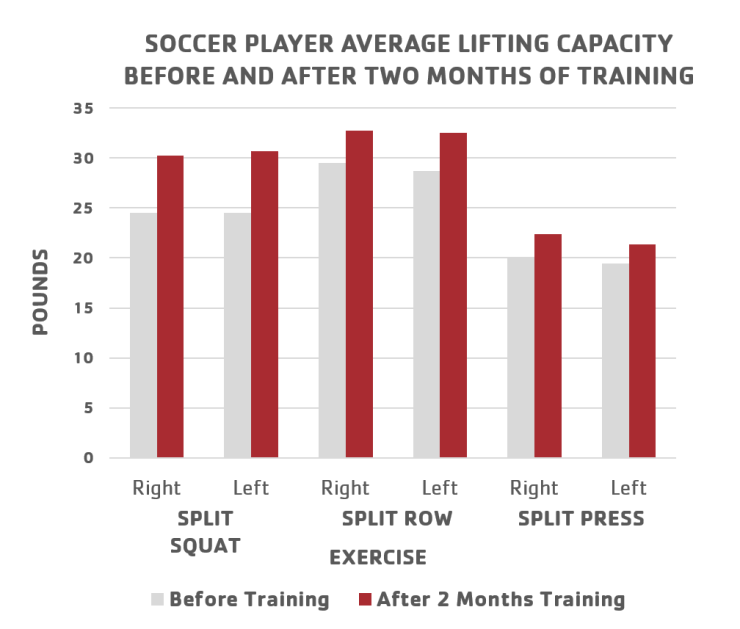
The first chart shows the before and after weights in pounds that the girls were able to lift with each assessed maneuver. For split squat the average weight the girls were able to lift increased by 20%.
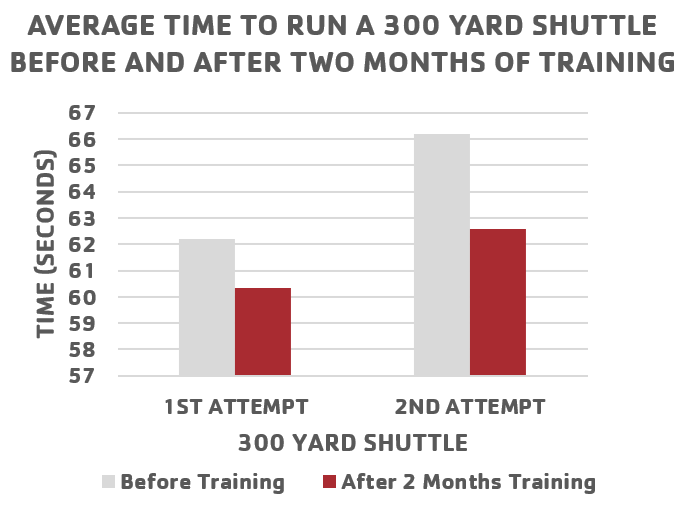
The next chart represents the change in average speed for a 300 yard shuttle. During each assessment the girls ran 2 separate 300 yard sprints to assess how quickly they could run the distance and ultimately how quickly they recovered between them.
After training the first shuttles speed decreased by roughly 2 seconds.
Second shuttle attempts decreased by roughly 4 seconds.
Running faster and recovering quicker is a huge part of soccer which is why this was our main focus.
These last two charts show our power tests which were divided into lower body, upper body and trunk power.
The athletes vertical jumps average increased by 14%.
The athletes’ average med ball throw distance increased by 4%.


The Plan
Here is how we got from A to B. Each girl had a warm-up that was tailored to them based on their movement assessment. Mind you, we had 20 girls that had one if not more painful patterns. Our goal was to put some stimulus in other nonpainful patterns so that it would help offset some of the overuse in the painful pattern. After their warm-up, they all went through the same dynamic warm-up, unless we saw something that needed to be customized.
After the dynamic warmup, they all worked on agility and power. We started off with some fast feet drills, half kneeling cable chops, single leg hops, and half kneeling Med Ball throws. We didn’t spend that much time on them. It was mostly 2 sets of each 5-8 reps of everything. Mainly because they saw these every time they came in for 4 lifts in a row. This not only follows the law of adaptation but also from a simplicity standpoint we had to keep things easy for them to remember but also make progressive. After that, some did box jumps, 2 sets of 5, while others went right into their conditioning work. Day 1 we only did 4 sprints. It was to set a baseline but also not push the girls to their max. Leaving room to add work each week was crucial.
We never did more than 25 seconds of high-intensity work. There was also required rest periods. For a 10 second all out Sparc Sprint athletes had to take a minimum of a one-minute break. This allowed for repeatable all-out efforts. By the end of the 1st training phase they worked up to 8 sprints(up from 4). The next training phase we dropped the volume down with sled pushes and started with 3 working up to 5. We used a minimum of 50% bodyweight for load and they had to move the sled roughly 20yds(split into 10yds with a 180 degree turn) in under 15 seconds.
Finally, we ended each training session with our strength lifts. We primarily loaded split squats, rear foot elevated split squats and reverse lunges. Based on what numbers they tested out for split squats we used roughly a 5-10lb decrease as a starting point and added reps or weight each week. We also progressed these lifts throughout the 6 weeks. Some that had knee issues only used posterior chain exercises like stability ball hamstring curls or partner hamstring holds. Combine these with push-ups, split stance 1 arm cable rows, jump chin-ups and goblets squats and you have all the strength work needed.
Something else to note is that even though we didn’t test the goblet squat as part of the assessments some athletes were able to increase from holding a 35lb Kettlebell in week 1 to holding 2 35lb kettlebells in the front racked position by week 6.
Athletes never did less than 6 reps until the last week where we decreased to 4.
“ Coach, when are we going to start lifting?“
One last observation about strength training from our girls that really stuck with me as I got asked a few times “coach when are we going to start lifting?” These girls were split squatting in some cases 50lbs for 10 reps each leg. That is 1000lbs moved in just one set. If that isn’t lifting then I don’t know what is!
They had the idea that if we weren’t back squatting or bench pressing then we weren’t “lifting”. Something to keep in mind is that we still got a great result without some of the big compound lifts.
It most likely would have taken us at least 2 weeks before the girls were familiar enough with proper technique to load the bar. If we had focused on back squats etc. we would have lost 1/3 of the summer to teaching technique. Why waste that much time when we got the result we were looking for without it? Ultimately the split squat is much less taxing on a low back, an area where most of the girls started with pain or dysfunction in extension. I also believe it to have more carry over to sport strength than a squat. Most of the game of soccer is played with one leg behind the other(not in a squat stance), it would make sense to train that pattern.
In Conclusion
There are TWO main takeaways from looking at this summer and the results.
1) From an individual standpoint –we didn’t have any athlete do worse than their first test. Some stayed the same on certain qualities like split stance cable press or upper body power qualities but in all fairness we didn’t spend that much time on them in our training. Our main concern was fitness (300yd shuttle) and lower body strength (split squat). It shows that keeping the focus on what we thought was important paid off. Rather than try to be good at everything we wanted a specific adaptation and in some cases we even got a little more.
2) From a team standpoint– The data shows that as a team if they were able to do this repeatedly over the course of the year by the same time next year they would have a drastically different team in terms of physical capability. The goal is to continue to develop these qualities so it allows them to tolerate the demands of their sport better. If all the girls are able to run for longer durations at higher intensities than their opponents and strong enough to compete for every 50/50 ball it can drastically change the outcomes of their soccer games.
It Takes A Team
In my opinion, you need to have each individual take it upon themselves to improve, but the team progression is what will ultimately lead to consistent winning. An example of this is seen in the NBA. The best players in the league weren’t winning championships until they had at least 2 other “good” if not “great” players around them. Michael Jordan has Scottie Pippen and Horace Grant, Paul Pierce had Ray Allen and Kevin Garnett, Lebron James had Dwayne Wade and Chris Bosh. In a team sport, of even just 5 players, sometimes having the best player in the league doesn’t mean you will win the championship. Having a team that is constantly progressing is crucial.
At the end of the day, there are a few things every training program should check off.
– Did the athletes stay healthy (your program isn’t contributing or causing harm)?
– Is there an objective metric you are trying to improve and how does it carry over to sport (300yd shuttle and lower body strength(split squat)?
– Is it flexible enough to allow for groups of all abilities to start and progress?
I think we did a pretty good job of checking those boxes off this summer with the SHS girls soccer team and had some fun in the process by closing sessions with some Spike Ball. Good luck to the team in their fall season!
(update- the girls went 15-1-0 this season 2018)
If you know an athlete or team that would benefit from our measurable and effective training programs contact me at tsienkowski7@gmail.com
 TS Training Systems