
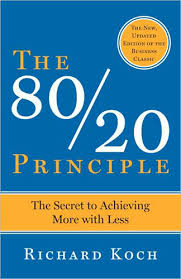
The 80/20 Principle
If you have ever heard the phrase “80% of your success comes from 20% of your effort” then you already have a good starting place for this article.
I had heard the phrase over and over for many years, but never fully grasped the concept. I had no idea where it had originated or if it was backed by credible evidence. I just thought it was people’s way of saying, “simplify your efforts and you will still get a great return”.
This message mainly came from strength coaches and trainers who were always fighting against the trends of the fitness industry. But after reading The 80/20 Principle: The Secret of Achieving More With Less, by Richard Koch, I have a much broader understanding of this important, fascinating, simple yet (potentially)life altering, message.
The main message is that there is an imbalance between our input and output. In most situations, you will find the majority of an outcome is derived from a small percentage of the actions exerted toward it. This is made every apparent in a business model. Koch describes most companies as having a small % (roughly 1-30%) of customers that make up the foundation of the revenue generated (70-99%). In this relationship, businesses often fail to grow because they still focus on the other parts of the company just as much as they do on the most profitable. If they were to change their practices and either get rid of or reduce their time on the less profitable areas, they could compound their gains exponentially.
How does this apply to training? I was given a program to review by an athlete that had SIX different leg exercises for one training day. If we are to use this principle, than 1.2 of his exercises will give him 80% of his success.
Does that mean he is just spinning his wheels with the other exercise choices? YES. I would argue that he is putting stress on his system that is unnecessary for adaptation. There is a line between what is too much and what is too little. The vast majority of people are equally divided between camps. Some will start off with not enough stimulus and continue even though they see no change. Others will try to do everything at once and not sustain the work rate or eventually breakdown.
How do you know what exercise is producing the most results? By experimenting and testing. Pick a program and finish it. Review your success or lack of. Go back and see what worked and what didn’t. We use this principle quite often in FMS screening. After the screen, we test correctives to see if we can get a change in movement. If not then the exercise is scrapped. This doesn’t mean it is a poor exercise, it just isn’t going to give us the best return. Reference back to the previous articles and figure out how you are going to measure if your results are working. Next, identify the outcome and analyze the information gathered. Use this data to adapt a new method or continue forward. You may not get it on the first try, but you can keep refining the process until you have a perfect blueprint for your own body.
This can be done with most people’s training programs. A lot of successful strength coaches and trainers only have a handful of exercises that they use to get the change they want. Not to mention there are really only a handful of human movement patterns that can be done safely to bring about positive change.

So as you start, or are currently engaged in your training endeavor, try to think about what is the 20% of your program that is yielding the most results. The key is to maximize this and grow.
 TS Training Systems